Background
There are many modules offered by the Faculty of Science that enable students to hone their presentation and writing skills. With regards to the content modules that science students take, there are limited avenues where students are able to receive comprehensive feedback on their scientific writing skills. For example, when tasked to write lab reports, often the headings that should be included in the report are briefly addressed. It would have been more beneficial if a certain lesson was dedicated in teaching the students the specific expectations of the headings included in the lab reports. Furthermore, it would be very useful to go beyond lab reports and teach how professional scientific reports are written. The teaching of scientific research writing skills is often neglected in the science curriculum.
Nevertheless, a variety of elective modules have been offered by the Faculty of Science in attempt to build scientific writing skills in students. These modules are not compulsory, and only a certain population of the Faculty of Science students takes up these modules. A few of these modules include:
ES2007S: Professional Communication: Principles & Practice
SP1202: Communicating with the Academy
SP1201: Freshman Seminar
SP2170: Doing Science (Module offered by Special Programme in Science)
ES2007S is effective in covering professional writing skills that would be important for business communication between respective individuals. This module is extended to engineering students, but neglects the aspect of scientific research writing skills. Instead it focuses on improving general communications skills essential in the working world. The next elective module is SP1202. This module is designed to specifically improve academic science writing as well as research writing skills of year one students. SP1201, which is similarly open only to year-one students, offers students with an opportunity to explore a scholarly topic in a small group with the expertise of a professor. This module, unlike SP1202, is more holistic, and covers more communication skills related to scientific thinking.
These modules covered so far are open to the general Faculty of Science population. Each module has its own strengths and weaknesses. However, only one module (SP1202) aims specifically to enhance scientific writing skills among students. Unlike the previous modules, SP2170 is only offered to students who are in the Special Programme in Science (SPS). This programme aims to nurture students with a strong passion and aptitude for science. Therefore, in this module, students gain valuable skills in literature review, and the writing and discussing of scientific papers. The modules differ from SP1202, in that it is angled towards equipping SPS students with effective writing skills that would enhance their learning experience in SPS.
Recommendations
From preliminary analysis of an ongoing survey, we can see that majority of students feel that inadequate written communication skills is the most common barrier to effective communication in scientific research. This could be attributed to the lack of practice as mentioned by Professor Helmer during his interview session.
Hence, in order to work towards the goal of making system changes to the NUS curriculum to better equip students with scientific writing skills, we would like to make the following recommendations.
1. Conduct more in-depth research to determine which aspects of scientific writing to focus on.
2. Search for teaching staff who are dedicated and have the relevant expertise to conduct the module.
3. Decide on the course outline, such that it meets the needs of Science and Engineering students.
4. Email Science and Engineering students to inform them about the new module and provide more information on CORS.
Comments: (6)
While I was doing an internship with an engineering firm, I had the chance to meet two newly-employed Thai engineers. I was able to communicate with them as they both spoke English.
On the other hand, they seemed to have problems communicating with their superior, who was the senior engineer of the firm. On several occasions, after delegating work to them, he asked if they understood and they always answered that they did. However, the Thai engineers did not carry out the tasks the way in which their superior had instructed them to. This behaviour puzzled those of us working there as they had little problem understanding us, yet they were unable to comprehend whatever the senior engineer said.
After some probing, we realized that the two engineers did not understand the Singlish that was used by their superior. He was Chinese-educated and while we locals could understand him, the Thai engineers could not make sense of what he said. Furthermore, we learned that it was considered rude in Thai culture to question your seniors or superiors. Due to this belief, the Thais acted as if they understood their superior even though they did not, as it would be considered rude and impolite not to do so.
Upon this realization, the senior engineer tried to converse in English when speaking to them. In addition, he would ask them questions to test their understanding, rather than to ask “yes” or “no” questions like he used to.
While it is important to abide by one’s culture and customs, I feel that the Thais could have made an effort to ask their fellow colleagues for help when they did not understand their superior’s instructions. After all, a simple mistake at such a firm could lead to dire circumstances. I also think that what the senior engineer did was commendable. Even though he was more used to speaking in Singlish, he was willing to step out of his comfort zone in attempt to communicate more effectively with the Thais. This shows the importance of respect for other cultures, in order to foster intercultural communication between groups.
On the other hand, they seemed to have problems communicating with their superior, who was the senior engineer of the firm. On several occasions, after delegating work to them, he asked if they understood and they always answered that they did. However, the Thai engineers did not carry out the tasks the way in which their superior had instructed them to. This behaviour puzzled those of us working there as they had little problem understanding us, yet they were unable to comprehend whatever the senior engineer said.
After some probing, we realized that the two engineers did not understand the Singlish that was used by their superior. He was Chinese-educated and while we locals could understand him, the Thai engineers could not make sense of what he said. Furthermore, we learned that it was considered rude in Thai culture to question your seniors or superiors. Due to this belief, the Thais acted as if they understood their superior even though they did not, as it would be considered rude and impolite not to do so.
Upon this realization, the senior engineer tried to converse in English when speaking to them. In addition, he would ask them questions to test their understanding, rather than to ask “yes” or “no” questions like he used to.
While it is important to abide by one’s culture and customs, I feel that the Thais could have made an effort to ask their fellow colleagues for help when they did not understand their superior’s instructions. After all, a simple mistake at such a firm could lead to dire circumstances. I also think that what the senior engineer did was commendable. Even though he was more used to speaking in Singlish, he was willing to step out of his comfort zone in attempt to communicate more effectively with the Thais. This shows the importance of respect for other cultures, in order to foster intercultural communication between groups.

Comments: (7)
Lee Shi-Chen Gwen
xx Sunrise Lane
Singapore xxxxxx
Mobile: (+65)9xxxxxxx
Home: (+65)6xxxxxxx
Email: u0703864@nus.edu.sg
7th February 2010
Mrs M. Cairns
Campus Recruiter
Bloomberg L.P
23 Church Street
Capital Square
Singapore 049481
Dear Mrs. Cairns,
I am enclosing my resume in response to your advertisement for the above post which appeared in The Straits Times on 5th February 2010.
I am currently a final year student from the National University of Singapore, pursuing a Bachelor’s degree in Science with specialization in Statistics and Applied Probability. I have acquired a wide range of IT and finance-related skills during my three years there. As a Statistics major, I have experience in calculating numerical data and analyzing it, summarizing information and writing reports. I am also skilled in applying statistical software including R, SAS and SPSS for data analysis and forecasting.
While pursuing my studies, I worked as an intern at Winston Engineering. I was posted to the accounting department, where I organized files and verified financial accounts. In addition, I worked as a sales assistant during vacations. Handling customers and cashiering allowed me to interact with people at different levels. I learnt to be customer focused by anticipating their needs. As a sea scout, I had to organize a camp for students. Planning the event as a team leader taught me how to work effectively and efficiently as a group. I also gained strong interpersonal skills from my interaction with the camp participants.
In review of your company’s objectives and possible openings, I believe that I am qualified to meet your current needs. As a fast leaner with an innate curiosity for financial structures, I would find the post of Professional Analytics Representative very challenging and fulfilling. I look forward to an opportunity to be part of the Bloomberg Professional Service, and I hope you will look favorably at my application. I can be reached in confidence at one of the above telephone numbers and look forward to hearing from you.
Yours sincerely,
Lee Shi-Chen Gwen
xx Sunrise Lane
Singapore xxxxxx
Mobile: (+65)9xxxxxxx
Home: (+65)6xxxxxxx
Email: u0703864@nus.edu.sg
7th February 2010
Mrs M. Cairns
Campus Recruiter
Bloomberg L.P
23 Church Street
Capital Square
Singapore 049481
Dear Mrs. Cairns,
Professional Analytics Representative, Job Reference No. 24185
I am enclosing my resume in response to your advertisement for the above post which appeared in The Straits Times on 5th February 2010.
I am currently a final year student from the National University of Singapore, pursuing a Bachelor’s degree in Science with specialization in Statistics and Applied Probability. I have acquired a wide range of IT and finance-related skills during my three years there. As a Statistics major, I have experience in calculating numerical data and analyzing it, summarizing information and writing reports. I am also skilled in applying statistical software including R, SAS and SPSS for data analysis and forecasting.
While pursuing my studies, I worked as an intern at Winston Engineering. I was posted to the accounting department, where I organized files and verified financial accounts. In addition, I worked as a sales assistant during vacations. Handling customers and cashiering allowed me to interact with people at different levels. I learnt to be customer focused by anticipating their needs. As a sea scout, I had to organize a camp for students. Planning the event as a team leader taught me how to work effectively and efficiently as a group. I also gained strong interpersonal skills from my interaction with the camp participants.
In review of your company’s objectives and possible openings, I believe that I am qualified to meet your current needs. As a fast leaner with an innate curiosity for financial structures, I would find the post of Professional Analytics Representative very challenging and fulfilling. I look forward to an opportunity to be part of the Bloomberg Professional Service, and I hope you will look favorably at my application. I can be reached in confidence at one of the above telephone numbers and look forward to hearing from you.
Yours sincerely,
Lee Shi-Chen Gwen
The conflict described in the previous post is actually an ongoing problem between two of my friends. The general consensus from the comments posted is that Y is at fault and that V should initiate a talk with Y. I agree with this approach and will definitely advise V to work things out with Y. Thanks for the suggestions!
Comments: (6)
Last semester, Vand Y who were good friends, worked on a project together with three others. V was allocated the task of doing citations for their written report. After V had completed her part, she sent the report to Y, who was supposed to check the report before submitting it.
Y was unsatisfied with the way V did the citations, as she felt that V’s work was slipshod and not according to what they had discussed before. Y then spent the night re-doing the citations, as the submission deadline was the very next day. After which, she sent an email to the entire group to tell them what happened, and even highlighted to V that she should have put more effort into the task. V felt that Y had not been clear with her instructions from the start, and did not want to apologize as she felt that she was not in the wrong. After this incident, V and Y did not speak to each other.
During the December break, their mutual friend J had to leave Singapore for an overseas exchange program. J invited both V and Y to her farewell dinner. That night, Y spoke to V as per normal.
At the start of the new semester, V and Y were allocated with the same module. On the first day of school, V was late for class. When she arrived, she realized that Y had not saved a seat for her like she usually did. When the class was asked to form project groups, Y did not include V in her group. This made V unhappy as they had done projects together all the while. She thinks Y is being petty, while Y makes no effort to explain her actions.
As a mutual friend of V and Y, who do you think is at fault and what would you do to remedy the situation?
Y was unsatisfied with the way V did the citations, as she felt that V’s work was slipshod and not according to what they had discussed before. Y then spent the night re-doing the citations, as the submission deadline was the very next day. After which, she sent an email to the entire group to tell them what happened, and even highlighted to V that she should have put more effort into the task. V felt that Y had not been clear with her instructions from the start, and did not want to apologize as she felt that she was not in the wrong. After this incident, V and Y did not speak to each other.
During the December break, their mutual friend J had to leave Singapore for an overseas exchange program. J invited both V and Y to her farewell dinner. That night, Y spoke to V as per normal.
At the start of the new semester, V and Y were allocated with the same module. On the first day of school, V was late for class. When she arrived, she realized that Y had not saved a seat for her like she usually did. When the class was asked to form project groups, Y did not include V in her group. This made V unhappy as they had done projects together all the while. She thinks Y is being petty, while Y makes no effort to explain her actions.
As a mutual friend of V and Y, who do you think is at fault and what would you do to remedy the situation?
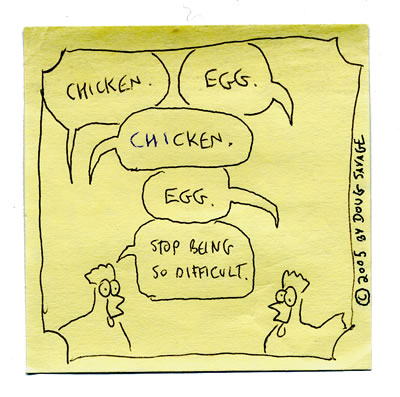
Credit: http://www.savagechickens.com
Jonathan Swift once said, “Argument is the worse sort of conversation.” I believe majority of us would try to avoid getting into arguments, or confrontations of any sort, if possible. Personally, I feel that arguments arise from misunderstandings, where both parties are unable to reach a consensus in an amiable manner. These misunderstandings are in turn caused by a lack of effective communication between individuals.
Inarguably, too many arguments can strain a relationship. Thus, as one who deeply values her relationships with others, effective communication skills are important for me, in order to reduce miscommunication with others.
Effective communication facilitates a two-way interaction between individuals, such that the sender can convey messages to others clearly and unambiguously, while the audience is able to understand the message that the sender wants to bring across. This form of two-way communication prevents miscommunication and reduces the probability of arguments occurring.
In addition, effective communication skills are essential for one to communicate competently in different social settings, whether with family members, in school, or at work. Hence, it is vital for us to grasp the concepts of written communication, job search communication and oral communication. Only this way, can we maintain healthy relationships with those we love, while building strong relationships with new acquaintances both at work and play. This is especially important for me, as I will be starting my professional career after graduating at the end of this semester, and I hope to establish good working relationships with my colleagues.